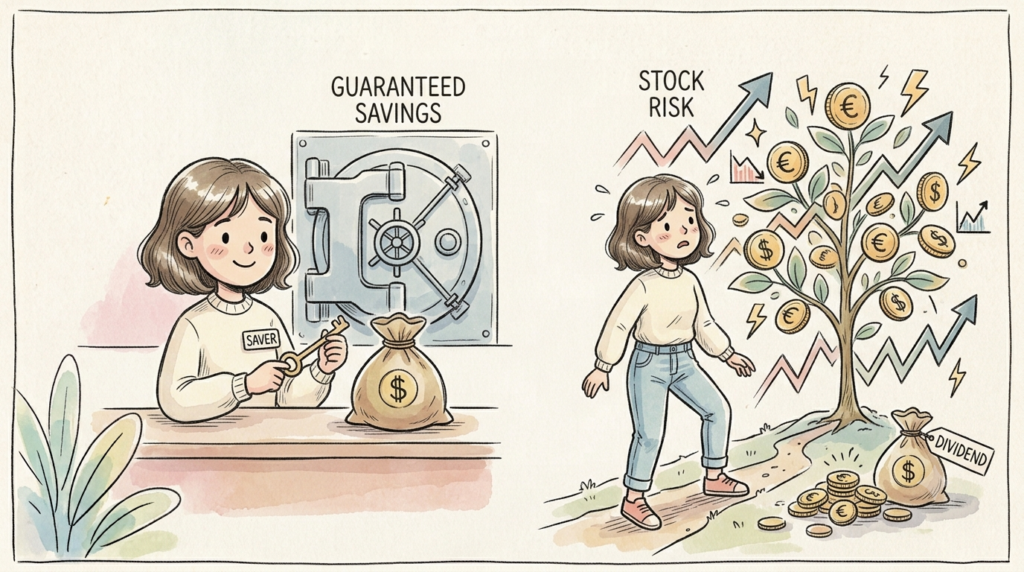
Whenever beginners or older family members talk about dividend stocks, one phrase always comes up: “This stock has a 5% dividend yield, which is way better than putting money in a bank savings account!”
To many people, “dividend yield” sounds like a high-grade upgrade to a bank deposit—put your money there, and you get a cash payout every year. But is that really true? If dividend yields and bank deposit interest rates shared the exact same DNA, why do we always hear about people losing their principal capital from stock investing?
This article breaks down the fundamental differences between dividend yields and bank deposit interest to help you build a sound asset allocation mindset.
Table of Contents
Understanding the Basics: Bank Interest vs. Dividend Yield
On the surface, both look like the same transaction: “Hand your money over to someone else, and collect interest or dividends later.” In the underlying logic of finance, however, they belong to completely different games:
- Bank Deposit (Capital Protection, Fixed Income):
- Principal Safety: Extremely high. In a legitimate bank, your principal is backed by deposit insurance and essentially safe from vanishing.
- Source of Return: A lending contract between you and the bank. The bank promises to pay you a fixed rate of interest, regardless of whether the bank makes or loses money that year.
- Price Volatility: Zero. If you deposit $1,000,000 today, it will still have a face value of $1,000,000 next year (ignoring inflation).
- Dividend Yield (Unprotected Principal, Earnings Distribution):
- Principal Safety: None. Your principal is the stock’s market value, which fluctuates daily based on market sentiment and company operations.
- Source of Return: Corporate profit sharing. If the company makes money and the board decides to distribute cash, you get a dividend; if the company posts a loss, the payout drops to zero. You can track whether this profit distribution is improving or worsening by looking at the payout ratio.
- Price Volatility: Severe. A $1,000,000 stock investment could become $1,200,000 next year—or plummet by half to $500,000.
Why Treating Dividend Yield Like Bank Interest Is a Disaster
Investors who mistake dividend yields for bank deposits typically stumble into these 3 dangerous traps:
1. “Interest” is a guaranteed promise; “Dividends” swing with the wind
Bank interest is a contractual guarantee. But stock payouts change every year. A company paying $5 a share last year might cut it to $1 during an industry downturn—or eliminate it entirely. Relying on dividends as a fixed cash flow for living expenses often leads to sudden financial stress during economic tight spots.
2. Ignoring invisible “principal erosion”
If you put money in a bank deposit and earn 1.5% interest, your $1,000,000 principal remains $1,000,000.
But if you buy a high-yield stock that pays a 5% dividend ($50,000) while its share price drops 15% ($150,000) due to sector decline:

You thought you earned a 5% “interest rate,” but your total net worth actually shrank by $100,000. This is the biggest blind spot of looking only at yield instead of total return.
3. Different psychological pressure for liquidity and liquidation
Early withdrawal from a bank deposit only forfeits a portion of the interest; your principal stays intact.
If a bear market hits while you hold stocks and you urgently need cash, you are forced to sell at the bottom, turning unrealized drops into permanent capital losses.
How Should We Properly View Bank Deposits and Dividend Stocks?
This doesn’t mean stock investing is bad. Rather, they serve completely different functions within a comprehensive financial plan:
- The Role of Bank Deposits: Defense and Short-Term Cash FlowBest suited for emergency funds or money you cannot afford to lose over the short term (1–3 years). Their value lies in liquidity and absolute capital preservation. Beating inflation isn’t their strong suit, but they serve as your financial safety net.
- The Role of Dividend Stocks: Long-Term Asset Growth and Corporate SharingThe essence of stock investing is “becoming a business owner.” You aren’t chasing a tiny percentage of interest; you are betting on whether the enterprise can grow its earnings, expand its pie, and generate a total return (dividends plus compounding capital gains) that outpaces inflation over the long run.
The Ultimate Distinction: Risk and Symmetrical Return
At this point, what is the single biggest difference between the two?
The answer is risk. Bank deposits are essentially risk-free investments, whereas stocks carry the possibility of losing your entire principal. Once we acknowledge that investing involves risk, we must demand symmetrical returns—trading the discomfort of capital volatility for the chance of long-term compounded wealth growth. That is what makes an investment truly worth it.
Part 1:How to Calculate Dividend Yield? Don’t Get Fooled by High Yields!
Part 2:Dividend Yield vs. Bank Deposit: What’s the Real Difference?
Part 4:What Is TTM Dividend Yield? The Historical Data Trap Most Dividend Investors Fall Into
Part 6:What is the Dividend Yield Percentile? A Must-Know Valuation Metric for Dividend Investors
Part 8:What Is Annualized Return? Plus Free Annualized Return Calculator