If you spot a friend $1,000 and they pay you back $1,080 a year later, that extra $80 is interest—a 3% return.
It is that simple: money grows when time works in its favor.
Sure, keeping cash in a standard savings account technically counts as stashing money, but when most people talk about “investing,” a brick-and-mortar bank passbook or a low-yield digital app isn’t what comes to mind.
1. Your Savings Account is Losing Money Silently
Let’s look at the numbers. Traditional U.S. savings accounts and certificates of deposit (CDs) often hover around a certain yield, but let’s say you’re getting a generous 2% to 3% in a high-yield savings account (HYSA).
Sounds decent and safe, right?
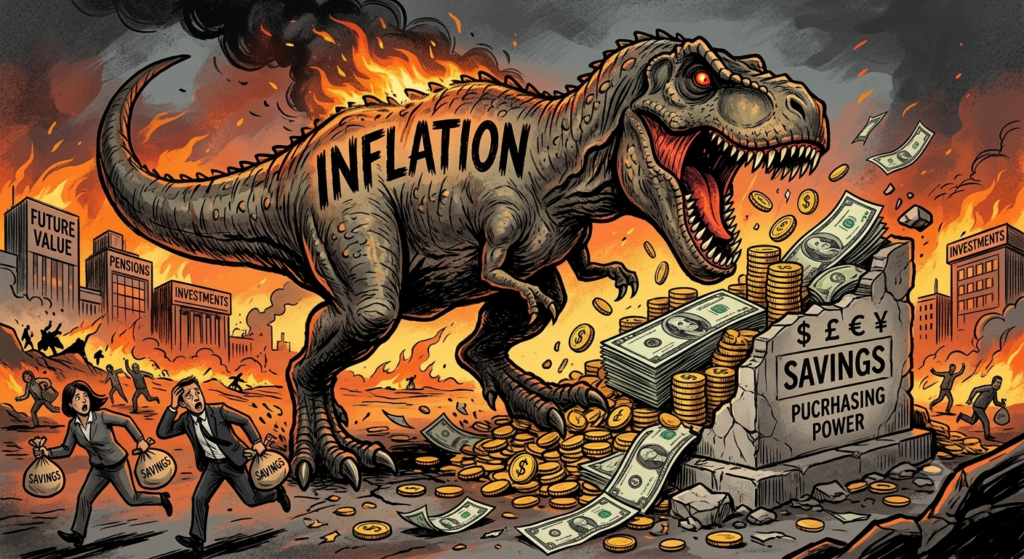
Meanwhile, historical U.S. inflation frequently hovers around 3% to 4%. If your cash is earning 2.5% in interest while inflation is running at 3.5%, you are actually losing 1% of your purchasing power every single year.
The numbers on your mobile banking app look safe, stable, and completely unchanged. But what that money can actually buy at the grocery store or the gas station quietly shrinks.
You might not want to admit it, but that is the reality.
This is the fundamental difference between saving and investing:
| Feature | Saving | Investing |
| Primary Goal | Zero loss, high liquidity | Grow purchasing power over time |
| Main Risk | Paper safety, but eroded by inflation | Market volatility, but targets real long-term growth |
| Best Used For | Emergency funds, short-term cash needs | Long-term idle cash, retirement, wealth building |
Both have a place in your financial life. Stashing 3 to 6 months of living expenses in an emergency fund is non-negotiable—liquidity has real value, and you don’t want to liquidate assets during a market downturn.
The problem begins when all your money sits in cash, mistaking “paper safety” for “real security.” They are not the same thing.
2. Investing not equal to Gambling: It’s About the Framework, Not the Asset
When people hear “investing,” they often picture Wall Street day traders treating the stock market like a casino.
But the line between investing and gambling (or speculating) is sharp: it’s not about what you buy, but how you make the decision.
- Investing is rooted in the fundamental value of an asset—analyzing whether a company’s cash flows, business model, and dividend yields justify its current share price.
- Speculating is chasing short-term price momentum—ignoring the underlying value and only betting on whether the price will spike tomorrow or next week.
The exact same stock can be an investment for one person and a speculative gamble for another. The difference lies entirely in the investor’s mindset, not the ticker symbol.
This is a blind spot for many long-term dividend investors, too. Simply holding a stock for years doesn’t automatically make you an investor. If you bought it purely because social media hype said “to the moon,” you’re just running a very long, very expensive gamble.
3. Take Back Control of Your Money
Where is your cash sitting right now?
List it all out: checking accounts, HYSAs, CDs, individual stocks, or retirement funds like a 401(k) or Roth IRA. What is the actual annual return on each?
There is no single “correct” answer, but building the habit of auditing your assets is step one toward understanding how money actually works.
Once you stop letting all your cash idle in dead-end accounts and start looking at yields, cash flows, and annualized returns, you stop being a passive victim of inflation. You let time work for you.
If you want to evaluate how your current assets can generate a steady stream of passive income, check out our tools to run the numbers and see if your money is actually pulling its weight.
Financial freedom isn’t about pinching every penny—it’s about buying yourself future options.
Disclaimer: This article is for informational and educational purposes only and does not constitute financial advice. Always do your own research or consult a licensed financial advisor before making investment decisions
Part 1:How to Calculate Dividend Yield? Don’t Get Fooled by High Yields!
Part 2:Dividend Yield vs. Bank Deposit: What’s the Real Difference?
Part 4:What Is TTM Dividend Yield? The Historical Data Trap Most Dividend Investors Fall Into
Part 6:What is the Dividend Yield Percentile? A Must-Know Valuation Metric for Dividend Investors
Part 8:What Is Annualized Return? Plus Free Annualized Return Calculator