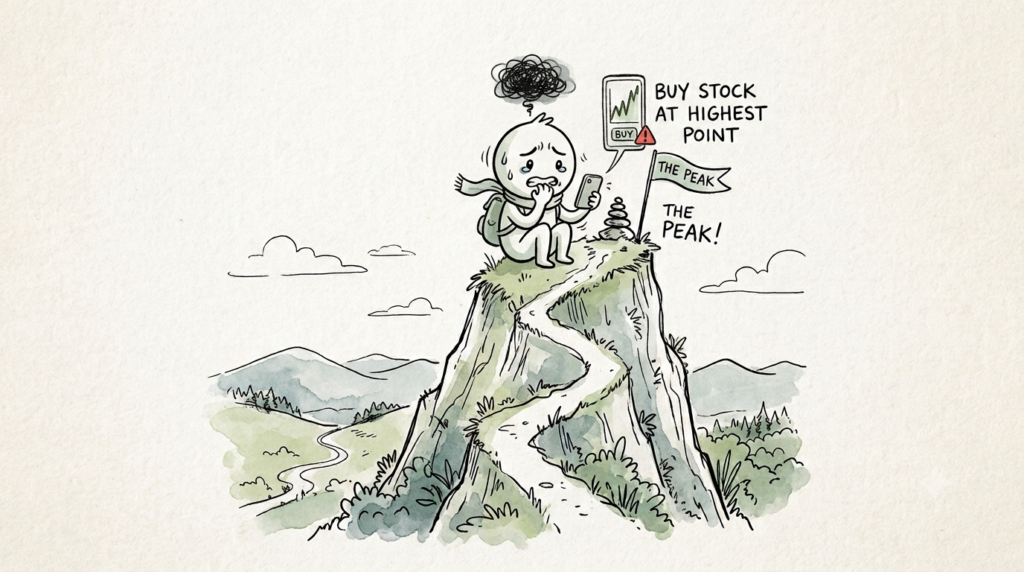
What to Do When Buying Stocks at All-Time Highs? Understanding the Long-Term Foundation Through Annualized Returns
Every time a dividend investor or long-term investor finally saves up some money and confidently enters the stock market, only to experience buying stocks at all-time high prices right before a market correction or bear market begins, panic inevitably sets in: “Did I buy at the absolute top and get trapped? What should I do now?”
This anxiety of buying near a market peak is something almost every investor who has experienced market volatility can relate to. However, if we zoom out and look at it through the logic of annualized return rates and asset compounding, do short-term entry prices really dictate the ultimate success or failure of your long-term investment?
This article will equip you with rational math and data-driven confidence, helping you understand why time in the market almost always beats timing the market.
Table of Contents
Why Does “Buying at the Peak” Always Feel Like the End of the World?
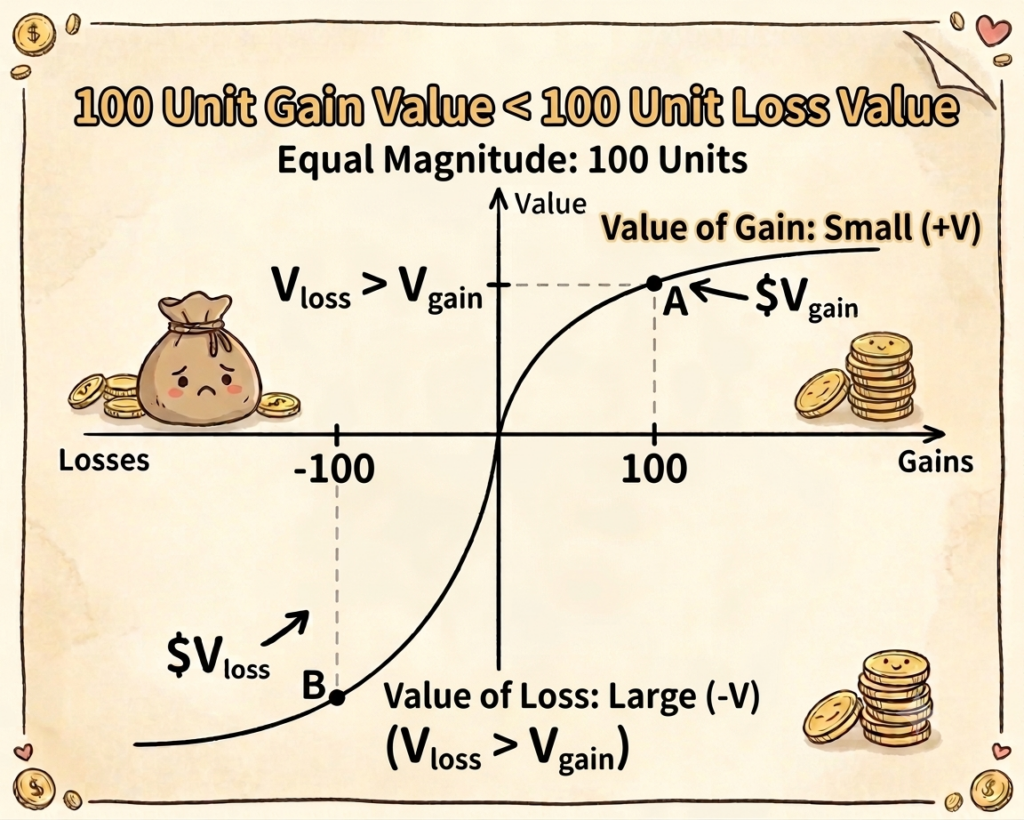
Human psychology is wired to be extremely sensitive to “losses.” The moment you invest your hard-earned principal and see red numbers (negative returns) on your account screen the next day, your brain’s fear mechanism instantly triggers:
- Loss Aversion: The psychological pain of a loss is far greater than the joy of an equivalent gain. As behavioral economics experiments have proven, losing $100 triggers a much stronger emotional reaction than gaining $100.
- The Perfectionism Myth: The lingering belief that investing is only “successful” if you buy at the absolute bottom and sell at the absolute peak. Buying at a high feels like committing an unforgivable mistake.
However, the reality of the market is: No one can consistently and accurately predict the absolute peaks and valleys. Even if an investor were truly “unlucky” enough to always buy at the most expensive price of each year, would they necessarily lose money in the long run? The answer might completely shatter your preconceived notions.
Debunking the Peak Myth with “Annualized Returns”
To evaluate the true performance of an investment, looking only at immediate “paper gains or losses” is inaccurate. You must use the Compound Annual Growth Rate (CAGR) to restore the actual growth velocity of your capital under the power of time compounding.
Imagine a hypothetical investor with the worst possible timing:
- On the first trading day of every single year, they take all their available capital and buy entirely at that year’s all-time stock price peak.
- They never use dollar-cost averaging, nor do they ever wait for market dips; they purposely step in to load up on the hottest, most expensive day of the year.
Sounds like a recipe for absolute financial disaster, right? But if we extend our horizon to 15 or 20 years or more, and look at a highly resilient, mature stock market like the US S&P 500, the outcome often turns out completely different.
It is crucial to note that high-quality assets in such markets survive cycles and deliver long-term growth primarily driven by three core forces interacting in various proportions:
- Cyclical Factors (Macro economy and business cycles)
- Growth Factors (Corporate earnings and fundamental expansion)
- Innovation Factors (Technological advancement and industrial upgrading)
In practical execution, this leads to several key transitions:
- Short-Term Traps and Volatility Convergence: Although an investor’s initial cost basis looks terrible in the short term and their account frequently faces paper losses, even when hit by the “cyclical factors” of an economic downturn, long-term “growth” and “innovation” will relentlessly push enterprise value upward—eventually breaking past those historical peaks. As the holding period lengthens, the volatility of annualized returns gradually converges toward a stable median.
- The Birth of a Micro-Valley: As time marches forward, corporate earnings growth, nominal asset inflation driven by inflation, and the compound effect of dividend reinvestment will slowly compress that past “all-time high” into a barely noticeable ripple on the historical chart.
- The Confidence to Beat Bank Deposits: Ultimately, the annualized return rate will not only show positive growth, but its compounding explosion will far surpass locking money away in a bank savings account.
This is why we say: Time is compounding’s best friend, and the ultimate antidote to peak-buying anxiety.
Three Strategies for When You Accidentally Buy at the Peak
That being said, when you actually buy at the peak and real paper losses hit, the psychological pressure is completely genuine. When this happens, you can use these three steps to adjust your mindset and strategy:
1. Verify Your Capital’s Purpose: Will You Need This Money Soon?
If the money you used to buy at the peak is your “emergency fund” or a down payment you need to spend within 1 to 2 years, then yes, this creates a genuine financial crisis. But if it is long-term capital (truly idle money), as long as the underlying company fundamentals haven’t deteriorated, price volatility is just “paper wealth”—there is no need to panic and cut losses.
2. Balance Logic and Human Nature: From Lump-Sum to Dollar-Cost Averaging
From a purely statistical standpoint, a lump-sum investment usually outperforms dollar-cost averaging (DCA) over the long run because “waiting” is its own form of hidden cost. However, in real-world investing, human emotion is often the ultimate deciding factor. If being fully invested leaves you anxious, losing sleep, and unable to stomach the swings, then “paying a tiny holding cost to enter in batches or via dollar-cost averaging” to secure peace of mind is your best solution. When the market pulls back because of the “peak” you encountered, subsequent periodic purchases will automatically scoop up cheaper units, riding out the smile curve.
3. Shift Focus from “Short-Term Price Spreads” to “Business Value and Cash Flow”
If you bought broad-based ETFs or rock-solid mature enterprises, a temporary pullback in share price does not mean the companies have stopped operating. As long as businesses remain stably profitable and continue generating cash flow, the “number of units” you own is quietly increasing through automatic dividend reinvestment. When the market eventually cycles back into a bull run, those accumulated cheap shares will unleash explosive portfolio growth.
Conclusion: Short-Term Entry Is Just Noise, Long-Term Compounding Is the Real Foundation
Returning to the original question: What should you do when you buy stocks at the all-time high?
The answer is: As long as the assets you hold are high quality and possess long-term upward momentum, accept it, and let time do the work.
Short-term price fluctuations are like sudden gusts of wind on the ocean—they will rock the boat, but what determines how far you can sail is always the engine and direction of the ship itself. Cultivating a proper understanding of annualized returns and grasping the underlying foundation of long-term asset growth will ensure you never lose sleep over a temporary peak again.
Part 1:How to Calculate Dividend Yield? Don’t Get Fooled by High Yields!
Part 2:Dividend Yield vs. Bank Deposit: What’s the Real Difference?
Part 4:What Is TTM Dividend Yield? The Historical Data Trap Most Dividend Investors Fall Into
Part 6:What is the Dividend Yield Percentile? A Must-Know Valuation Metric for Dividend Investors
Part 8:What Is Annualized Return? Plus Free Annualized Return Calculator